
NEWS

Organisations are looking at innovative ways to support their employees’ well-being and stability. Many employees have caring responsibilities for both children and elderly relatives – the sandwich generation. This can impact their work and their health. Homeshare schemes offer support to those workers and are a valuable addition to an organisation’s employee benefits package. 

Eight reasons HR should be considering integrating homeshare into their benefits package:

1. Reduces absenteeism

Supporting employees with caring responsibilities helps decrease unplanned leave; carers in the UK miss an average of 15 days of work annually (Carers UK).

2. Increases workforce stability

Around 60% of UK carers consider leaving their jobs due to a lack of flexible support, risking the loss of valuable skills (CIPD).

3. Improves productivity

Employees who receive support are 16% more likely to meet performance targets, according to research by Mind, the mental health charity.

4. Boosts employee engagement and morale

58% of UK employees say work-life balance significantly affects their wellbeing, and supportive policies improve morale (CIPD).

5. Promotes a positive workplace culture

Organisations known for caring policies and supportive benefits are 24% more likely to report higher employee engagement and satisfaction levels (CIPD)

6. Reduces recruitment and training costs

Replacing a skilled employee can cost up to 200% of their annual salary; retention through supportive schemes minimises these costs (CIPD).

7. Enhances employer brand

According to a 2023 survey by Willis Towers Watson, organisations with comprehensive wellbeing programmes are 34% more likely to attract top talent and report higher employer brand reputations.

8. Supports workforce longevity

UK demographic shifts are leading to a rapidly aging population; by 2040, one in seven people will be aged 75 or over, increasing caregiving demands and the need for workforce support (Government Office for Science).

Integrating homeshare schemes into your benefits offering helps both employees and their employers. It fosters a resilient workforce and positions your organisation as a caring leader.

Two Generations can help

Learn more about our employee benefits offering here or speak to the team today about how Two Generations can help your organisation better support caregiving employees.

Call us now on 03333 44 7738.

The UK is facing an affordable accommodation crisis, driven by rising housing costs, limited supply, and stagnant wages. In July, the government introduced a 5-step plan aimed at revitalising social and affordable housing over the next decade. However, with the prospect of the Autumn Budget potentially causing more disruption to the housing market, innovative solutions are needed now to address affordable housing.

One promising approach is the promotion of mixed-generation households, such as our Homeshare scheme. At Two Generations, we match people who live alone and have a spare room with younger individuals who can provide an overnight presence, companionship, and assistance with household chores. This model makes better use of spare rooms, offers mutual support, and helps combat social isolation and financial strain. According to the Office for National Statistics (ONS), over the past 12 months, housing costs have risen by 5.5%, outpacing income growth and making affordable housing more elusive.

Our model also benefits the Homesharers by reducing loneliness. Age UK recently reported that 1.4 million older people experience loneliness, a shocking statistic. Sharing a home nurtures social connections and emotional support. Moreover, it reassures families that their elderly relatives can remain in familiar surroundings, supporting their independence and enabling them to stay in their own homes longer. 

Home sharing is a practical and sustainable solution to housing affordability, social isolation, and empty spare rooms—crucial as we work towards a more inclusive and resilient housing market. 

How Homeshare works

Many older people have a spare bedroom that can accommodate a Homesharer who can provide companionship and light support. It can be as simple as having a trusted person in the home at night or sharing a meal regularly.

“We’ve seen a huge difference in her confidence. She is definitely no longer lonely; they make a great team!” Daughter of Lynn, Householder, Richmond

You can read more testimonials from Householders and their families, and Homesharers here. Or get in touch with the team to find out more.


The population is aging, public funding is stretched, and families are having to step in.

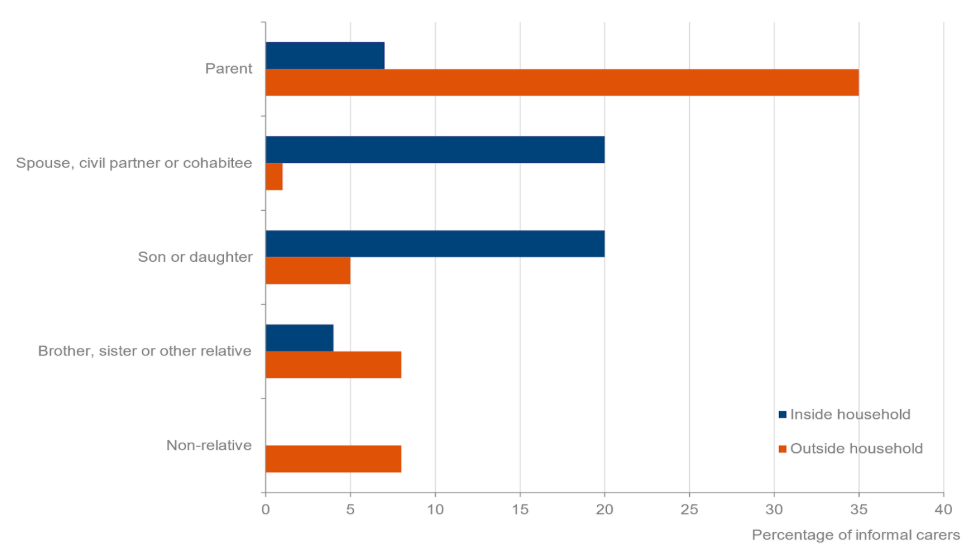
The Family Resources Survey estimates there are 5.4 million informal carers in 2023/24. These numbers highlight the scale of unpaid care provided, with millions of individuals supporting family members and friends, particularly the elderly. A significant proportion of these carers will be working for SMEs (in 2024, SMEs employed 16.6 million people in the UK). 

Informal carers by care recipient, 2023 to 2024, United Kingdom (Family Resources Survey Financial Year 2023-2024)

The number of working carers is set to rise; SMEs will need to be prepared.

What SMEs can do

An eldercare strategy will help organisations retain valued employees (especially women 45-60), maintain productivity, and reduce staff turnover costs in the years ahead. 

Eldercare requires a different approach to childcare. It is complex, difficult to plan for, and often it’s not local. It can also be hidden; we are aware of our colleagues’ children, but not necessarily their elderly relatives. This means that employees won’t always identify as carers or know how to ask for help. 

We have produced a guide specifically designed for SMEs using a low-admin practical approach.

Benefits for early adopters

The long-term winners are SMEs that address the issue early and engage in an ongoing conversation with their employees about the support they need. 

Benefits:

  • Retention of experienced staff in at-risk roles
  • Reduction in last-minute absences
  • Improved focus and productivity
  • Lower stress levels and improved work-life balance
  • A more loyal workforce

Two Generations SME Homeshare model

Two Generations helps employers support working carers through Homeshare, a managed, safeguarding-first service that provides reliable, affordable support at home for employees’ older relatives. Designed for 50-300 employees, our SME model has UK-wide access, an annual management fee, and a 50% employee discount for those who use the scheme. 

Contact us for a consultation.

Caring for ageing parents is no longer a niche issue. Around 1 in 5 UK workers now provides unpaid care, and more than 600 people leave work every day because of caring pressures—costs that add up to an estimated £4.8 billion a year for employers in absence and turnover. In smaller organisations, even one reduced schedule or unexpected absence can strain delivery and client continuity. Many employees can’t afford unpaid time off, so caring pressures spill into the workday, driving stress, last-minute gaps and, too often, preventable leavers

This short guide outlines a proportionate, low-admin approach for SMEs.  The aim is simple: help people sustain both work and care, while protecting your operations.

Why this matters for SMEs

Smaller teams run with thinner cover. When a key person is pulled away by caring responsibilities, projects slip, rota strain rises, and colleagues pick up unsustainable slack. Over time, morale and retention suffer, particularly among mid-to-senior level women, who are disproportionately affected by eldercare.


Three practical moves that work together

1) Use the Carer’s Leave Act

The Carer’s Leave Act provides up to one week of unpaid leave per year for long-term care needs. It’s a useful breathing space for short-term crises (hospital discharge, urgent appointments). Treat it as one tool in the kit, helpful, but not the full answer when people can’t afford unpaid time away.

Next steps: publish a one-page policy and a manager crib-sheet (what it is, how to request, how to plan cover).

2) Create a Carers’ Forum so issues surface earlier

A light, employee-led group (monthly or bi-monthly) normalises the conversation, shares practical tips and signposts support. It helps people ask for help before things become emergencies.

Next steps: name a sponsor, set a simple agenda, add a private Teams/Slack channel, and capture FAQs for your intranet.

3) Offer Homeshare – practical support at home

Our Homeshare employee benefit pairs an employee’s older relative (the Householder) with a carefully vetted companion (Sharer) who lives in and provides companionship and around 10 hours a week of light help (meals, errands, tech help) in exchange for affordable accommodation.  This gives employees peace of mind that their loved one is being looked after so they can concentrate on work.

For SMEs, this is a managed employee benefit with UK-wide access, a nominal annual management fee, and a 50% discount for employees who use the scheme. It’s designed to stabilise working hours, reduce last-minute absences and retain experienced staff, without adding HR workload.

Key outcomes & measurements

Set a framework so you can see impact without heavy admin.

  • Reduction in last-minute absences linked to eldercare (month-on-month).

  • Stability of hours for identified carers (pre- vs post-support).

  • Retention of experienced staff in at-risk roles (especially women 45-60).

  • Utilisation: record enquiries and active cases (Homeshare and other routes).

  • Manager feedback: perceived impact on rota strain/client continuity (quarterly).

  • Cost avoidance (indicative): estimate prevented leaver(s) vs typical replacement cost.

Caring for older relatives is no longer just a personal issue but a business issue; it is a defining feature of today’s workforce. For SMEs, the right response is practical and proportionate: clear policy, early visibility, and dependable support at home. Done well, it keeps people in work, protects client delivery, and strengthens culture, without building a large programme or costing a fortune.

Two Generations helps employers support working carers through Homeshare, a managed, safeguarding-first service that provides reliable, affordable support at home for employees’ older relatives. The SME model is designed for 50-300 employees, with UK-wide access, an annual management fee, and a 50% employee discount for those who use the scheme.  Contact us for a consultation.

Companies have realised the benefits of offering childcare support, so why not eldercare? 

The 2021 ONS census for England and Wales found that nearly 10% of the workforce are carers, while 38% of the workforce are working parents, often, they’re both. Yet while the majority of UK companies offer childcare support, only 14% offer adult carer support (REBA article). 

Why does this matter? 

The bottom line: Employers for Carers, calculated that the impact of staff turnover, absence, and stress due to juggling work and caring is costing UK businesses over £8.2 billion per year. With better support for carers, businesses could save up to £4.8 billion a year in unplanned absences and £3.4 billion in improved employee retention (EfC: Business Case).

Eldercare is unpredictable and rarely structured: emergencies, hospital visits, and the emotional strain are harder to “plan around” than childcare.

The sandwich generation: employees (especially women aged 35–55) are burning out, reducing hours, or leaving altogether.

Organisations can take the lead on eldercare

Carers are often hidden in the workforce, particularly those caring for elderly relatives and friends. The benefits of supporting these employees are proven: increased productivity, retaining talent, and a more inclusive culture. One way to recognise and support your employees’ caring roles is to provide access to professional care advice and practical support through your employee benefits package. 

Offer peace of mind

The Two Generations Homeshare scheme is a UK-wide scheme that helps employees connect their elderly relatives with vetted live-in companions. Through our scheme, employees can arrange for a carefully vetted sharer to provide live-in companionship and support for an elderly relative.

From initial setup to ongoing support, we handle every detail, ensuring a hassle-free experience for both employers and employees.  

Benefits of Homeshare for employers:

  • Retains top talent & reduces absenteeism
  • Improves productivity & well-being
  • Strengthens DEI efforts
  • Minimal admin – employees contract directly with Two Generations

Learn more about our corporate offering here or speak to the team today about how Two Generations can help your organisation better support caregiving employees.

Call us now on 03333 44 7738.

We have seen an increased uptake in our Homeshare service; our testimonials show why.

“My sharer is just perfect. We are such a wonderful fit together, I couldn’t be happier.” Lilas, Perth

Combatting loneliness is often a big part of the appeal of a homeshare arrangement. Age UK published a study on loneliness at the end of 2024, which found:

  • 7% (1 in 14 people) aged 65+ equivalent to 940,000 older people in the UK are often lonely.
  • 270,000 older people (aged 65+) in England go a week without speaking to a friend or family member (3%, or around 1 in 40 people aged 65+).
  • People who go a week without speaking to a friend or family member are almost three times more likely to be lonely than people who speak to friends and family more often.


This matters because: 

  • Loneliness is linked with the acceleration of frailty and increased risk of physical and mental illness, including a 29% increase in risk of incident coronary heart disease, a 32% increase in risk of stroke and a 25% increased risk of dementia.
  • Loneliness is linked with increased risk of mental illness, including depression and anxiety.
  • Nine in 10 older people who are often lonely are also unhappy or depressed, compared to four in 10 of those who are hardly ever lonely.

(Age UK link to findings and how to combat loneliness)

How Homeshare helps

Many older people have a spare bedroom that can accommodate a Homesharer who can provide companionship and light support. It can be as simple as having a trusted person in the home at night or sharing a meal regularly.

“We’ve seen a huge difference in her confidence. She is definitely no longer lonely; they make a great team!” Daughter of Lynn, Householder, Richmond

You can read more testimonials from Householders and their families, and Homesharers here. Or get in touch with the team to find out more.

A recent study by PwC, Women in Work 2025, calculated that increases in women’s participation in the workforce contributed to a productivity uplift of 0.30% per year, an approximate UK GDP increase of £6.2bn a year. This is talent that many businesses will want to access and benefit from. Yet significant barriers remain as women in their critical career advancement phase often find themselves juggling caregiving responsibilities for children and elderly relatives. 

The Glass Ceiling in Action

At the point of earning promotions and taking leadership roles:

  • women are 7X more likely than men to leave work for caregiving (TUC, 2023)
  • 1.46M women can’t work due to family duties (TUC, 2023)
  • 84% of “sandwich carers” (work, kids, aging parents) are women (Age UK, 2022)

What Can Businesses Do?

Businesses recognise the value in a diverse workforce and are looking for ways to better support their people. Until recently the focus has been on childcare provisions;  eldercare is less visible and more complicated. And there isn’t a one size fits all here. Flexible working arrangements and unpaid leave is one approach many businesses are now taking. Great in a crisis, but probably not suitable for all ongoing caring needs. 


Another practical option is Homesharing,  a scheme that carefully pairs a householder (an older person with a spare room) with a vetted sharer who provides live-in companionship and light support in exchange for affordable accommodation.

Two Generations

Our Homeshare scheme offers a unique corporate benefit connecting employees’ elderly relatives with vetted live-in companions – creating peace of mind. 

Benefits for Employers:

  • retain top talent & reduce absenteeism
  • improve productivity & well-being
  • Strengthen DEI efforts
  • minimal admin—employees contract directly with Two Generations

Speak to the team today about how Two Generations can help your organisation support caregiving employees.

Call us now on 03333 44 7738.

When we think about “care”, we often picture personal care. Washing. Dressing. Hospital visits. Social care packages. Nurses and care homes.

But real care, the kind that keeps people going day to day,  is often smaller and quieter.

It’s the cup of tea made mid-morning. The chat over breakfast. Help getting the iPad to work. Someone sleeping in the next room, just in case.

These small things don’t sound like “care” in a policy document. But they are what make older people feel safe, seen, and less alone.

The Care We Don’t Count

There are 5.7 million unpaid carers in England and Wales. Many are family members or friends. They help out because they care, but also because there is no one else.

More than 1.4 million older people in the UK are often lonely, according to Age UK. Over half a million go at least five days a week without speaking to anyone.

These numbers are rising. And they don’t just point to a health problem,  they point to a support gap.

Most people want to stay in their own home as they age. But that depends on more than care plans. It depends on someone popping in. Knowing there’s help nearby. Feeling less alone at night.

This kind of support is rarely funded, tracked or measured. But it’s what gives people the confidence to keep living independently.

Why It Matters Now

The UK is ageing fast. By 2043, 1 in 4 people will be over 65. We can’t build our way out of this – there won’t be enough care homes or formal carers.

And with rising costs and staff shortages, traditional care services are stretched. We need to think differently.

That means recognising the full spectrum of care. Not just what happens in hospitals or care homes, but what happens in kitchens, hallways, spare rooms.

Rethinking Support

Solutions like Homeshare offer one answer. A younger person lives with an older householder, offering company and a few hours of help in exchange for affordable rent.

It’s not formal care. But it offers presence. Company. Peace of mind. And that has real value.

By broadening what we think of as “care”, we open up new ways to support people. We also lighten the load on families, services, and the NHS.

A Policy Shift Waiting to Happen

Too often, care is only counted when it breaks down,  when someone is hospitalised, or needs a crisis package. But the early signs, the gaps filled by neighbours, friends, adult children, are where real prevention happens.

If we want more people to age well at home, we need to see care as more than tasks and timesheets.

We need to start valuing presence, not just procedures.

Sources:

We’re thrilled that our Head of Service Delivery, Lisa Goldsobel, recently joined Avivah Wittenberg-Cox on her Elderberries podcast to discuss one of today’s most pressing and overlooked challenges: the growing need for eldercare — and its impact on families, communities, and the workplace.

Avivah, a globally recognized thought leader on gender and generational balance, continues to lead the conversation on the future of work, the longevity economy, and the promise of 60-year careers.

Together, Avivah and Lisa explored how intergenerational living can help address two critical issues at once: the isolation often faced by older adults and the lack of affordable housing for younger generations.

Lisa shares her experiences of working closely with families that have used Two Generations homeshare, offering an honest look into the realities and rewards of intergenerational living.

🎧 Listen to the episode here:


A big thank you to Avivah for creating space for these stories and for her ongoing support of Two Generations as an ambassador.

It is time to recognise and support working carers through organisations’ employee benefits packages.

The 2021 census showed that at least 5.8 million people across the UK were providing unpaid care for an ill, older, or disabled family member or friend. The number of carers is expected to grow over the next 10 years and is taking its toll on the workforce. 

Photo by Age Cymru on Unsplash

The State of Caring 2024 survey of UK carers found 80% of working carers feel overwhelmed juggling work and care.  However, “almost a third of working carers in the UK have not discussed their caring role with anyone at their workplace, most commonly because they believed that nothing would change as a resultCIPD.

Hidden in plain sight

Carers are often hidden in the workforce, particularly those caring for elderly relatives and friends. Organisations will benefit from supporting those carers (with increased productivity, retaining talent, and a more inclusive culture), but only if employees are comfortable disclosing their caring responsibilities. How can employers encourage more transparency from their workforce?

Employee Benefits Schemes

One way to recognise and support your employees’ caring roles is to provide access to professional care advice and practical support through your employee benefits package. Alongside promoting positive practices and training for managers, signposting to support gives employees options tailored to their circumstances. 

Create peace of mind

The Two Generations Homeshare scheme is a subscription service that helps employees connect their elderly relatives with vetted live-in companions. Through our scheme, employees can arrange for a carefully vetted sharer to provide live-in companionship and support for an elderly relative. From initial set-up to ongoing support, we handle every detail, ensuring a hassle-free experience for both employers and employees.  

Benefits of Homeshare for employers:

  • Retains top talent & reduces absenteeism
  • Improves productivity & well-being
  • Strengthens DEI efforts
  • Minimal admin—employees contract directly with Two Generations

Learn more about our corporate offering here or speak to the team today about how Two Generations can help your organisation better support caregiving employees.

Call us now on 03333 44 7738.